This morning I was going through my Google Scholar notifications, and found a title that looked unfamiliar.
The title said “From electrons to environments and back: practices and practicalities in microbiology beyond reductionism and complexity”.
I like unfamiliar. So I clicked on it to see what it was about.
I find abstracts a bit overrated. So, as I usually do, I skipped a bunch of random pages in the PDF file and started reading it from a completely random part of it. When I do this I feel like I am jumping into a wall of rope and trying to hold onto something. If I fail to grab anything, I continue falling to the next article. And so it goes. Please note that I am saying this here in my own blog post, where I am not to be judged, thankyouverymuch.
The first sentence that caught my attention was the following:
I have never seen Donato Giovannelli in a lab coat, yet he is perhaps the lab PI I have seen tinkering with microbes the most.
As a seasoned reader of articles that have microbiology or complexity in their titles, I immediately recognized that this was different than the work I often read. I like unfamiliar, but don’t always like different: I am drawn to things that are new to me, but I do not always enjoy work that operates in a fundamentally different mode than what I value because I am simply a human. But I am also a big fan of the Giovannelli Lab, and that was enough for me to climb all the way back to the beginning of this article, and see how this author had found their way to Donato.
And when I finally made my way back to where I randomly started, I had learned along the way that my favorite labs in this work were not limited to the Giovannelli Lab, but also included the laboratories of Victoria Orphan and Dianne Newman. What a lovely day.
The article I am talking about is one by Valentina Marcheselli, and I am here writing about it because I want you to know about it.
Based on the body of work I found on the Google Scholar profile I linked above, I guess I would describe Marcheselli as a researcher who is, in a very general sense, focusing on sociology of scientific knowledge. Marcheselli’s body of work seems to visit the intersection between science and technology, the place of society in science and vice versa, and how scientific knowledge is produced in emerging disciplines, this time, in microbiology.
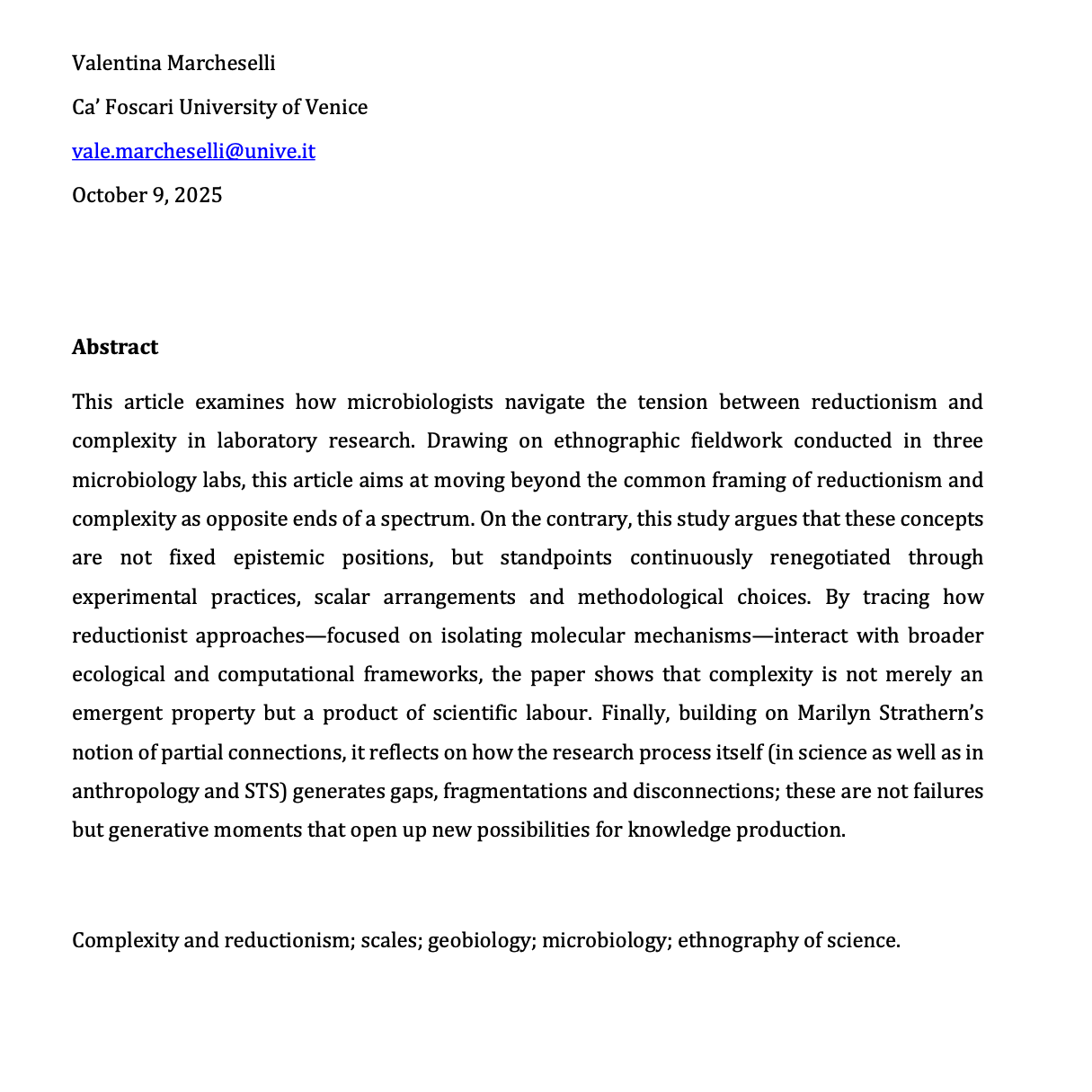
“From electrons to environments and back: practices and practicalities in microbiology beyond reductionism and complexity” is a GORGEOUS title, and I guess I don’t need to say more about this work to convince most of you to read it. You will find it here, so please feel free to leave this blog post and read it:
https://sciety.org/articles/activity/10.31235/osf.io/vq9yt_v1
But I do have a few more things to say about it if you are interested.
The paper shines its gaze into microbiology through ‘ethnography’ of three microbiology labs. Ethnography is one of those words that I know what it means, but I actually don’t. So at some point reading this paper I had to really make sure I comprehend its meaning. According to Wikipedia, it is “a branch of anthropology and the systematic study of individual cultures”. So that’s what Marcheselli did here: took part in the daily routines and practices of three microbiology labs to study their individual cultures with the aim of finding answers to a particular question: how do real scientists position themselves on the reductionism / complexity spectrum of science, which often portrayed as the opposite ends of our disciplines.
From Marcheselli’s observations at three different labs and their practices, emerges the notion that reductionism and complexity are not opposing forces on a fixed spectrum, but rather transitional standpoints that are continuously redefined through everyday practices, where changing scales, instruments, or constraints we work with reshape how we understand life, determine what is knowable, and where we stand in that elusive spectrum at a given time and for a given question.
I’d say Marcheselli’s work is a form of poetry. That brings familiar things from different ends, and helps them meet in the middle in surprising ways. As a microbiologist of sorts, I was very impressed by the way the text flowed through some quite critical concepts in microbiology. It is a lesson on how to write about difficult concepts without trivializing them. And that by itself would have been enough reason to justify the time to read this work carefully.
But apart from that, it also is extremely good at delivering two things in my opinion, which makes it more important for microbiologists to read:
- An accurate portrayal of microbiologists as thoughtful practitioners that humbly question, question again, adjust, and adapt rather than those with fixed minds with fixed methods and goals.
- A refreshing interpretation of the dynamic and un-anchored nature of the terms we use to describe what is simple, what is complex, what is tractable, and what is context-dependent, rather than fixed positions of vocabulary in the spectrum of science.
As they go from pure cultures, to environmental samples, to geochemical transects, The Newman, Orphan, and Giovannelli labs are absolutely great choices for this work given how much they differ from one another on how they navigate through the tension between reductionism and complexity. But I also felt that something was missing in this otherwise rich discussion of practices and practicalities in our discipline.
There is an entirely different dimension to the reductionism / complexity tension: one that plays out in the computational space, where algorithms turn complex realities into simple sketches by reducing dimensions of data unjustifiably, or they turn simple observations into complex puzzles by accumulating enough errors to create their new stories along the way.
In that sense there is also something to be understood about how our software history and culture in microbiology (or any emerging discipline for that matter) shapes what kinds of surveys are worth making and what kinds are OK to skip, and what kinds of questions we can ask to the data that emerge from our surveys, and what kinds of questions we can’t. Our place in the reductionism / complexity spectrum for individual questions is often force-fed to us in unexpected ways due to our choice of computational tools we rely upon. Which is not a criticism by itself, but in my opinion it is also worth thinking about since computation has become an inseparable aspect of everything now.
I have to mention, I was also extremely honoured to see that our work with Jill Banfield, which boldly calls modern microbiology a place of embracing complexity through integration across scales, made its way into Marcheselli’s work due to our admittance that even the most well-controlled lab systems conceivable present us with overwhelming complexity. I think to a certain degree we all are lost and found continuously in modern microbiology, and it is great to see that fluctuation in the famous axis of reductionism and complexity throughout the culture and practices of three different labs.
As I was trying to summarize what really resonated most deeply with me and stuck in my mind from my reading of this study, I came to the conclusion that it was the following: the ideal scientific practice is likely the one that teaches us to find our peace with unresolved tension rather than trying to resolve it prematurely. An idea that is not necessarily a point of this manuscript, but one that speaks to the power of social science, and to its capacity to provoke reflection by creating space for conversation rather than closure.
Overall, I think this is a rare opportunity to reflect back on our discipline through the eyes of someone who uses the power of ethnography, story telling, and great observations as connective tissue that carries you from the beginning to the end, and think more about how we align ourselves and our science with what we think matters.